

Optimal polymerization kinetics and photoinitiator activation are critical factors influencing the best temp for resin printing. Achieving precise thermal conditions ensures consistent layer curing, dimensional accuracy, and mechanical strength in photopolymer-based additive manufacturing. The best temp for resin printing is not simply a fixed value but a dynamic parameter intertwined with resin chemistry, printer calibration, and ambient environment control.
Understanding the interplay between temperature and resin viscosity, as well as the rate of ultraviolet light-induced cross-linking, is essential for producing high-fidelity prints with minimal defects. As advancements in resin formulations and printer hardware continue to evolve, identifying the optimal temperature range becomes increasingly pivotal for maximizing output quality and print reliability.
Delving deeper into the factors determining the best temp for resin printing reveals complexities that can significantly impact both prototype development and end-use applications.
Unlock the Secret: What’s the Best Temp for Resin Printing?
| Image | Product | Price |
|---|---|---|
Our Pick 1  | ELEGOO Smart Mini Heater for Resin 3D Printer Intelligent Temperature | Check Price On Amazon |
Our Pick 2 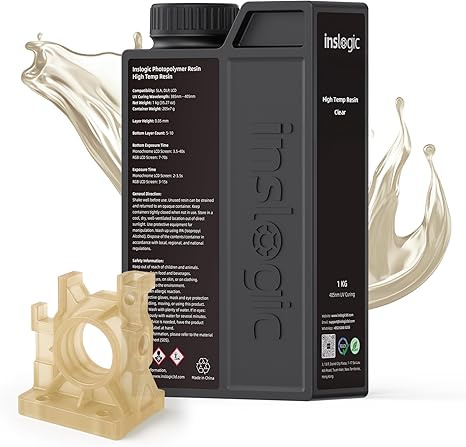 | Inslogic High Temp 3D Printer Resin, Functional Resin 405nm DLP | Check Price On Amazon |
Our Pick 3  | Siraya Tech Cast 3D Printer Resin Easier to Burn and | Check Price On Amazon |
1. ELEGOO Smart Mini Heater for Resin 3D Printer Intelligent Temperature
Achieve flawless resin 3D prints with the ELEGOO Smart Mini Heater, designed for intelligent and precise temperature management. This compact heater maintains consistent warmth inside your printer enclosure, preventing common issues like warping and detachment for smoother, higher-quality results every time.
Integrating advanced PTC rapid heating technology, the ELEGOO Mini Heater delivers fast, efficient warmth while its self-regulating element ensures safety from overheating. With a powerful 10,000 RPM fan for even heat distribution and an air filtration system for a clean print environment, it’s optimized for a variety of ELEGOO Saturn and Mars printers.
Pros
- Intelligent temperature control keeps enclosure temperature steady, reducing print failures due to cold conditions.
- Rapid PTC heating technology ensures quick warm-up times and prevents overheating through self-regulation.
- High-speed fan (10,000 RPM) promotes uniform heat distribution, eliminating hotspots and improving print consistency.
Cons
- Compatibility limited primarily to ELEGOO printer models; requires enclosure modifications for use with other brands.
The ELEGOO Smart Mini Heater is an excellent addition for anyone facing temperature challenges in resin printing, especially in cooler environments. Its seamless integration with ELEGOO printers and effective temperature management delivers consistent print quality, making it a worthwhile investment for hobbyists and professionals alike.
2. Inslogic High Temp 3D Printer Resin, Functional Resin 405nm DLP
Inslogic High Temp 3D Printer Resin offers exceptional heat resistance and durability, making it an outstanding choice for demanding functional applications. Engineered to endure temperatures up to 300°C without warping, this resin combines strength, precision, and weatherproof qualities for reliable industrial and engineering-grade 3D prints.
Designed for 405nm DLP and compatible with 99% of LCD, DLP, and SLA printers, Inslogic’s resin delivers rigid, impact-resistant models with outstanding dimensional stability even under stress. The low-odor, scratch-resistant formula ensures clean prints, while leak-proof packaging safeguards the resin during transport.
Pros
- Withstands heat up to 300°C for short durations without deformation, ideal for high-temp prototypes and parts.
- Produces strong, rigid prints resistant to impact, bending, and scratching, suitable for functional and industrial uses.
- Compatible with a wide range of 3D printers (365–405nm), combined with a low-odor, easy-to-clean resin formula.
- Features precision dimensional stability under heat and mechanical stress, ensuring accurate and reliable finished parts.
- Leak-proof bottle design with airbag wrap prevents spills during shipment, making storage and handling worry-free.
Cons
- Post-curing times recommended by the manufacturer are relatively short compared to some other tough resins, which might concern users aiming for maximum strength.
Combining heat resistance, toughness, and print precision, Inslogic High Temp 3D Printer Resin excels in producing durable, functional parts. It stands out for professionals and hobbyists needing reliable performance under demanding conditions without compromising on detail or finish quality.
3. Siraya Tech Cast 3D Printer Resin Easier to Burn and
Siraya Tech Cast 3D Printer Resin offers an exceptional blend of ease and precision for casting enthusiasts. Designed to burn cleanly with minimal ash residue, this castable resin is ideal for creating detailed, thicker jewelry pieces and metal parts without the hassle commonly faced with other resins.
Boasting a bright true blue hue, this resin delivers high-resolution prints with smooth surfaces and excellent plate adhesion. It prints quickly without the need for a strictly dry environment or additives, making it suitable for both newcomers and experienced users using LCD, DLP, and SLA 3D printers.
Pros
- Contains wax for easier and cleaner burnout, leaving minimal ash—perfect for thick and complex designs like bracelets and metal parts.
- High-resolution prints with smooth, glossy surfaces enhance intricate details, ideal for crafting precision jewelry and dental models.
- Does not require special additives or extremely dry printing conditions, facilitating faster, more user-friendly SLA, DLP, and LCD printing workflows.
Cons
- Printed models can be fragile prior to post-curing, necessitating careful handling to avoid damage before final strengthening.
Overall, Siraya Tech Cast resin stands out as a reliable choice for those seeking clean burnouts and high detail in castable 3D prints. Its balance of printability and superior burnout characteristics makes it especially suitable for jewelry makers and metalcasting professionals aiming for quality results with less waste.
4. Up to 536℉(280°C) 3D Printer Resin, High Temperature resina, High
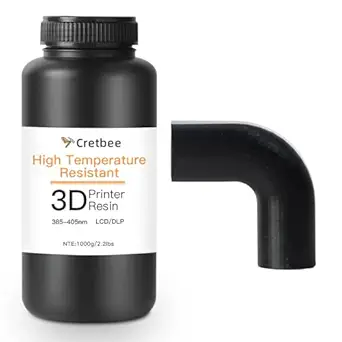
Discover reliable high-temperature performance with the Up to 536℉ (280°C) 3D Printer Resin by Cretbee. Engineered to withstand extreme heat without deforming, this resin delivers outstanding stability and precision for advanced resin printing projects that demand durability and fine detail.
Formulated for exceptional heat resistance and rapid curing, this resin maintains structural integrity up to 280°C and resists cracking during long-term exposure to high temperatures and humidity. Its low shrinkage properties ensure smooth finishes, while compatibility with popular DLP/LCD printers makes it versatile across various industrial and creative applications.
Pros
- Withstands temperatures up to 280°C (536℉), ideal for demanding manufacturing and molding tasks
- Rapid curing time of 2-3 seconds per 0.05mm layer under high-intensity light enables efficient printing workflows
- Ultra-low volumetric shrinkage ensures smooth surfaces and reduces post-processing effort
Cons
- Requires specific temperature preparation (heating to 60℃ and cooling under 30℃) before use, adding a step to the printing setup
Perfectly suited for professionals and hobbyists seeking a heat-resistant resin solution, this product balances durability with print precision. Its unique formulation supports small-batch production and intricate designs, making it a standout choice among high-temperature resins on the market.
5. Mini Heater for 3D Printer, Resin 3D Printer Temperature Controller

Achieve precise temperature control for your resin 3D prints with the Mini Heater for 3D Printer by YOUYOUTE. Designed specifically to maintain the ideal heating range, this compact yet powerful device ensures consistent resin viscosity and optimal curing conditions, even in colder environments.
This temperature controller allows users to easily set a target temperature from 10°C to 50°C, with 30°C being optimal for resin printing. Its robust design supports continuous 24/7 operation, featuring a high-precision sensor accurate to
Compact dimensions make it a perfect fit for resin printers sized 8 to 15 inches, quickly boosting ambient temperature by up to 40°F within 10 minutes.
Pros
- Adjustable temperature settings between 10°C and 50°C, enabling precise control tailored to different resin requirements.
- Durable construction equipped with a dual-sided PCB and professional wiring, ensuring reliable continuous operation without performance degradation.
- Compact and lightweight design (10.8 x 5.7 x 3.2 cm, 117 grams) fits neatly inside small resin printers, especially beneficial for models like the Anycubic Mono 4 Ultra.
Cons
- Limited maximum temperature of 50°C may not accommodate resins requiring higher heating thresholds.
Optimized for resin 3D printing in cool environments, the YOUYOUTE Mini Heater ensures stable print quality by maintaining the best temp for resin printing. Its user-friendly controls and reliable performance make it a valuable accessory for hobbyists and professionals aiming to enhance their printing results.
Consider this model if you need a compact, efficient solution designed specifically for resin-based 3D printers.
6. ELEGOO Upgraded 8K Standard Photopolymer 3D Printer Resin 405nm UV-Curing

Experience unparalleled precision and vibrant colors with the ELEGOO Upgraded 8K Standard Photopolymer 3D Printer Resin. Designed to minimize shrinkage while delivering high-definition results, it offers an exceptional printing experience for hobbyists and professionals seeking flawless finishes and reliable performance.
Formulated for fast curing at 405nm wavelength, this resin balances speed and stability, ensuring your models print quickly without compromising detail. Compatible with most DLP and LCD 3D printers, it features excellent fluidity and consistent hardness, reducing failed prints and producing durable, smooth parts with vivid coloration.
Pros
- Low volume shrinkage during photocuring guarantees highly accurate models with smooth surfaces.
- Fast curing time paired with stable resin consistency reduces print failures and enhances productivity.
- Rich, pure pigments and photo-initiators create bright, stunning colors that bring printed pieces to life.
- Broad compatibility with LCD 3D printers makes it a versatile choice for various printing setups.
- Leak-proof, secure packaging ensures the resin remains safe and intact during shipping and storage.
- Produces parts that are strong and less brittle compared to other standard resins, enhancing durability.
Cons
- Available primarily in specific bottle sizes, which may not suit users requiring smaller quantities.
The ELEGOO Upgraded 8K Standard Photopolymer Resin stands out as a dependable and vibrant material for detailed 3D printing projects. Ideal for users seeking a balance between speed, color fidelity, and precision, it delivers consistently superior results, making it a smart choice within the photopolymer resin category.
7. Siraya Tech Sculpt High-Temp Resistant 3D Printer Resin – Up

Experience exceptional durability and precision with Siraya Tech Sculpt High-Temp Resistant 3D Printer Resin. Engineered to withstand temperatures up to 180°C, this resin excels in producing heat-resistant prototypes and molds, transforming your 3D printing projects into professional-grade, high-performance parts.
Siraya Tech Sculpt resin offers outstanding thermal stability without compromising surface smoothness or detail accuracy. Its unique ceramic-filled formula minimizes shrinkage and delivers a dark grey finish that reduces post-processing work. Ideal for injection molds and vulcanized rubber applications, it also enhances other resins when mixed.
Ideal for injection molds and vulcanized rubber applications, it also enhances other resins when mixed.
Pros
- Outstanding heat resistance up to 180°C, suitable for high-temperature manufacturing and prototyping
- Low volume shrinkage ensures precise dimensional stability and smooth surface finishes
- Acts as a performance booster when blended with lower HDT resins, improving thermal tolerance and resolution
Cons
- Requires precise bed leveling and carefully calibrated z-height due to its opacity and ceramic-filled composition, posing a slight learning curve for beginners
Designed for specialized applications demanding thermal and chemical resistance, Siraya Tech Sculpt resin is a top choice for professionals looking to create durable molds and prototypes. While requiring careful print setup, its superior rigidity and surface quality deliver results unmatched by typical resins.
8. SUNLU Standard 3D Printer Resin Plus, Fast-Curing Photopolymer Resin for
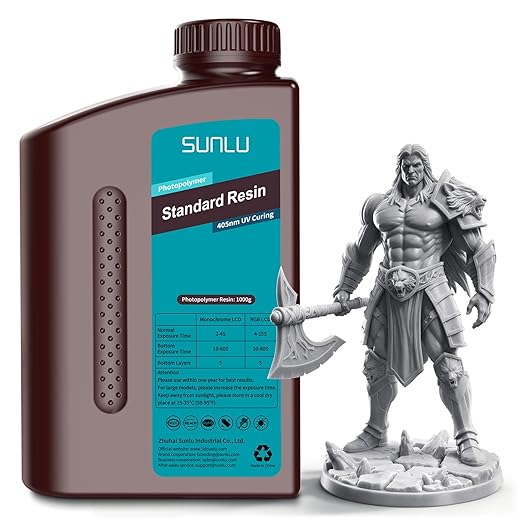
Discover exceptional precision and reliability with SUNLU Standard 3D Printer Resin Plus, a fast-curing photopolymer designed to elevate your resin printing projects. Its user-friendly formulation and broad compatibility make it an excellent choice for both beginners and experienced makers seeking detailed and durable prints.
Boasting strong fluidity and quick curing, this resin effortlessly adapts to various printers and print speeds, ensuring consistently smooth and firmly formed models. It offers low shrinkage for accurate dimensions, chemical resistance for lasting durability, and a hard, smooth finish suitable for easy post-processing and coloring.
Pros
- Exceptional printer compatibility with a curing wavelength range of 365-405nm, supporting most LCD, DLP, and SLA machines.
- Low-shrinkage formulation guarantees precise dimensions, minimizing deformation during curing and post-processing.
- Leak-proof patented bottle design ensures safe transportation and mess-free handling, preserving resin quality.
Cons
- Requires additional pigment for vibrant coloring when using the white resin variant, which may extend preparation time.
Combining affordability with high-quality results, SUNLU Standard 3D Printer Resin Plus is ideal for hobbyists and professionals aiming for detailed, durable prints without a hefty investment. Its versatility and ease of use make it a reliable choice for varied 3D printing applications where precision and finish matter most.
9. ANYCUBIC 3D Printer Resin, ABS-Like Resin Pro 2 with Enhanced

ANYCUBIC 3D Printer Resin, ABS-Like Resin Pro 2 with Enhanced toughness and strength, offers an exceptional balance of durability and precision for demanding 3D prints. Its improved elongation and low shrinkage make it ideal for structural parts and detailed prototypes requiring robust performance and sharp detail.
Engineered for high fluidity and reduced curing time, this resin ensures smoother printing with fewer failures thanks to superior backplate adhesion. Its low-viscosity formula allows quicker drainage and easier cleaning, while a low-odor composition enhances the printing environment for comfort and convenience.
Pros
- Significantly improved toughness with over 100% increase in elongation at break, making prints highly durable and resilient under stress.
- Excellent precision and low shrinkage minimize distortion and enable highly detailed, sharp, and vivid model finishes ideal for prototypes and functional parts.
- High fluidity combined with low viscosity shortens curing time, boosts printing success rates, and simplifies post-print cleaning processes.
Cons
- Priced higher than standard ABS-like resins, which may be a consideration for hobbyists on a strict budget.
ANYCUBIC ABS-Like Resin Pro 2 is perfectly suited for professionals and advanced users who require strong, precise, and reliable prints. Its optimized formulation outperforms many comparable resins in durability and print quality, making it a worthwhile investment for structural and high-detail applications.
10. ANYCUBIC 3D Printer Resin, 405nm SLA UV-Curing Resin with High

ANYCUBIC 3D Printer Resin offers an exceptional balance of precision and durability, tailored for users seeking high-quality SLA prints. Its low shrinkage and rapid curing properties ensure smooth surfaces and detailed outcomes, making it a top choice for hobbyists and professionals alike aiming for reliable and accurate 3D models.
Formulated to reduce curing time while maintaining strong stability even in moist or corrosive environments, this 405nm UV-curing resin delivers impressive rigidity and toughness. Compatible with a wide range of DLP and LCD 3D printers, it provides versatility alongside excellent fluidity and multiple color options for creative freedom.
Pros
- Low shrinkage during photocuring ensures high precision and smooth surface finishes, reducing post-processing work.
- Quick curing formula with outstanding fluidity speeds up printing without compromising the model’s stability in challenging environments.
- Combines hardness and toughness effectively, allowing easy removal from build plates while preserving detailed print features.
- Broad compatibility with all DLP/LCD 3D printers, optimized for ANYCUBIC LCD systems and available in multiple vibrant colors.
- Secure packaging guarantees leak-free delivery, preserving resin quality right out of the box.
Cons
- Requires thorough shaking before use to avoid uneven coloration, which may be a minor inconvenience for some users.
With its precise formulation and user-friendly features, the ANYCUBIC 3D Printer Resin is an excellent option for detailed SLA printing projects. Ideal for creators who prioritize print quality and durability, it stands out among standard resins for its reliable performance and versatility.
How to Find the Best Temp for Resin Printing Every Time
Temperature control features
Accurate management of resin temperature is critical to achieving consistent print quality and optimal curing performance.
Resin sensitivity to temperature variations means that even slight fluctuations can affect viscosity, layer adhesion, and curing times, ultimately impacting the precision and durability of printed models. Having the ability to set precise temperature parameters or choose from presets tailored to specific resin formulations ensures the environment stays within ideal operating ranges, preventing defects such as warping or incomplete curing.
Many printers either include built-in temperature regulation systems or support compatible external accessories like heated build plates, enclosure heaters, or temperature-controlled resin vats to help maintain a stable printing environment. Advanced models often feature real-time temperature monitoring through integrated sensors that provide feedback for automatic adjustments. Additionally, users can employ standalone digital thermometers or thermal cameras to track resin temperature during long print jobs.
Additionally, users can employ standalone digital thermometers or thermal cameras to track resin temperature during long print jobs. Such integration enables consistent thermal management, which is essential for complex prints or when working with temperature-sensitive resins, ensuring reliability and high-quality results.
Optimal printing temperature range
Maintaining the appropriate temperature during resin printing is critical to achieving consistent, high-quality results. Different resin formulations often require specific temperature ranges, typically between 20°C and 30°C (68°F to 86°F), to cure properly and avoid defects such as warping, incomplete curing, or tacky surfaces.
Many resin brands provide recommended temperature guidelines, but adjustments may be necessary depending on your environment or printer setup. For example, in cooler rooms, additional heating solutions might be required to maintain ideal conditions, whereas higher temperatures could cause premature curing inside the vat. Consistent temperature control is especially important for specialty resins, such as flexible or castable types, which often have narrower optimal ranges than standard photopolymer resins.
Consistent temperature control is especially important for specialty resins, such as flexible or castable types, which often have narrower optimal ranges than standard photopolymer resins.
Fluctuations in temperature during printing cause uneven curing speeds between layers, resulting in surface imperfections or internal stresses that can weaken the final model. Using an enclosed or heated build chamber, monitoring ambient conditions, and calibrating exposure times according to temperature changes contribute significantly to improving print reliability and detail fidelity across different resin formulations.
Resin handling and preheating requirements
Maintaining resin at an optimal warm temperature significantly improves print quality by reducing viscosity and enhancing layer adhesion. Resins stored or used at low temperatures tend to become thicker, which can hinder flow and cause uneven curing, leading to weak or distorted prints. Warming resin to around room temperature—typically between 20°C to 30°C—ensures it flows smoothly into fine details and bonds consistently between layers.
Safe warming techniques include placing resin bottles in a sealed container with warm water or using dedicated resin heaters designed to evenly raise temperature without exposing the material to direct heat or sunlight, which can prematurely cure or degrade the resin. Avoiding sudden temperature spikes preserves the chemical integrity and color of the resin, ensuring reliable print performance over time.
Storing resin in a cool, dark location at stable temperatures below 25°C helps maintain its longevity and print readiness. By controlling resin temperature before use, users can achieve more predictable viscosity, optimize curing times, and produce higher-resolution models with stronger structural properties.
Environmental temperature considerations
Maintaining a stable ambient temperature is critical to achieving consistent, high-quality resin prints. Fluctuations in room temperature can alter the resin’s curing process, leading to issues such as incomplete curing, warping, or uneven layer adhesion.
Even slight temperature variations affect the viscosity and polymerization rate of the resin, which in turn impacts the precision and durability of the final model.
Humidity levels combined with temperature also play a significant role, as excessive moisture can interfere with resin chemistry, causing cloudiness or reduced mechanical strength. A controlled environment helps minimize these risks, especially in spaces where seasonal or daily temperature swings are common.
Additionally, incorporating heaters or heated build plates ensures the printing chamber maintains an optimal temperature range, typically between 20°C and 30°C (68°F to 86°F), which supports ideal resin behavior.
Effective solutions include insulated printing enclosures, ceramic heating elements, or dedicated environmental control systems. These methods not only protect prints during the curing phase but also extend the lifespan of resin and printer components by preventing condensation and thermal stress. Overall, controlling both temperature and humidity is essential for precision, reliability, and optimal material performance throughout the entire printing process.
Temperaturerelated safety measures
Maintaining proper thermal conditions is essential to both the safety and efficiency of resin-based 3D printing processes. Resin can become hazardous when excessively hot, posing risks such as skin irritation or chemical burns during handling, especially immediately after printing when the resin remains warm and more reactive. Ensuring cool but stable temperatures helps users avoid thermal exposure and facilitates safer post-processing.
Overheating not only jeopardizes user safety but can also damage sensitive printer components like LCD screens and light sources, which degrade faster under elevated temperatures. Furthermore, uncontrolled heat fluctuations increase the likelihood of resin curing inconsistencies, such as incomplete polymerization or warping, which result in print failures and wasted material.
Maintaining ambient temperatures within recommended ranges—typically between 20°C and 25°C—protects both the user and the equipment from adverse effects. Active cooling strategies and proper ventilation prevent heat buildup inside the printer enclosure, extending hardware longevity and preserving resin stability. By integrating these precautions, users ensure safer operations and higher print success rates throughout the entire printing and post-processing cycle.
Frequently Asked Questions (FAQs)
Are There Specific Temperature Recommendations For Printing With Flexible Or Specialty Resins?
Yes, flexible and specialty resins typically require a controlled printing environment with temperatures around 20-30°C (68-86°F) to ensure optimal curing and handling. Keeping your printer and resin at a stable temperature within this range helps prevent issues like poor layer adhesion or excessive brittleness. Always refer to the resin manufacturer’s guidelines for exact settings, as some specialty formulations may have unique requirements.
Can Adjusting The Resin Vat Temperature Improve Print Quality Or Curing Times In Resin Printing?
Yes, adjusting the resin vat temperature can improve print quality and curing times. Warmer resin (around 25-30°C) tends to cure more consistently and quickly, reducing layer adhesion issues, while colder resin can slow curing and cause underexposure. Using a controlled heating setup can help maintain optimal temperature for better results.
What Is The Ideal Printing Temperature Range For Most Standard Resin Types In Resin Printing?
The ideal printing temperature for most standard resin types in resin printing typically ranges between 20°C to 25°C (68°F to 77°F). Maintaining this temperature ensures proper curing and adhesion while preventing issues like incomplete curing or excessive brittleness. For best results, keep your resin and printing environment within this stable, room-temperature range.
Which Temperature Settings Can Help Reduce Resin Curing Issues Or Failed Prints?
To reduce resin curing issues or failed prints, keep your printing environment and resin temperature between about 20-25°C (68-77°F). Avoid temperatures that are too low, which can cause incomplete curing, or too high, which may lead to over-curing and brittleness. Consistently maintaining this range helps ensure smooth resin flow and proper layer adhesion.
How Does Ambient Room Temperature Affect The Best Printing Temperature For Resin Printers?
Ambient room temperature affects resin viscosity and curing behavior, which means warmer rooms can allow for slightly lower printing temperatures, while cooler rooms may require higher temperatures to ensure proper layer adhesion and curing. Aim to keep your printing environment between 20-25°C (68-77°F) and adjust your resin’s recommended temperature by a few degrees based on the room’s actual temperature for optimal results.
Conclusion
In summary, finding the best temp for resin printing ensures optimal curing, improved detail, and stronger, more reliable prints. Maintaining the right temperature enhances the versatility of your resin printer, allowing you to achieve consistent results across various projects. Embrace the ideal printing conditions to unlock your resin printer’s full potential and create stunning, professional-quality models with confidence.