
Advanced additive manufacturing techniques and precision layering algorithms have revolutionized the design and production of protective headgear, making the best 3d printer for helmets a focal point in both industrial and personal safety applications. Selecting an optimal 3d printer involves evaluating factors such as material compatibility, build volume, resolution, and structural integrity, all of which contribute to producing helmets that not only meet stringent safety standards but also incorporate ergonomic and aerodynamic features.
As the demand for specialized, high-performance helmets grows across various sectors, understanding the underlying technology that defines superior 3d printing for helmets becomes crucial. Discover what cutting-edge developments and printer capabilities are shaping the future of helmet manufacturing and why this technology is increasingly indispensable.
Print Your Perfect Fit: Explore the Best 3D Printer for Helmets
| Image | Product | Price |
|---|---|---|
Our Pick 1  | Creality K2 Combo (A) 3D Printer, Multicolor Printing with CFS, | Check Price On Amazon |
Our Pick 2  | Creality K2 Pro Combo (A) 3D Printer, Multicolor Color Printing | Check Price On Amazon |
Our Pick 3  | Creality K2 Pro Combo (A) 3D Printer, Multicolor 3D Printer | Check Price On Amazon |
1. Creality K2 Combo (A) 3D Printer, Multicolor Printing with CFS,
Experience vibrant, multicolor 3D printing tailored for precision and durability with the Creality K2 Combo (A) 3D Printer. Designed for users seeking versatile functionality and effortless operation, this advanced printer excels at producing complex items like helmets with up to 16 colors without extra post-processing.
Equipped with up to four CFS units, the K2 Combo supports a generous 260×260×260 mm build volume, combining ultra-quiet, high-speed printing with smart features such as RFID filament recognition and AI-powered print failure detection. Its aerospace-grade aluminum frame ensures long-lasting stability and precision in every print.
Pros
- Multicolor capability via 4 CFS units enabling up to 16 distinct colors in a single print, eliminating the need for post-print painting.
- Smart RFID system paired with moisture-proof filament storage maintains material integrity and streamlines filament management for uninterrupted workflow.
- Robust build quality featuring aerospace-grade aluminum alloy frame and hardened steel drive gears supports printing with advanced materials including carbon fiber-filled filaments.
Cons
- Relatively heavy at nearly 66 pounds, which may limit portability or require a dedicated printing station.
Ideal for creators aiming to print complex, multicolor helmets or similar projects, the Creality K2 Combo offers an unmatched blend of speed, precision, and smart technology. Its rich feature set makes it a strong contender among high-end 3D printers focusing on detailed, large-format prints.
2. Creality K2 Pro Combo (A) 3D Printer, Multicolor Color Printing
The Creality K2 Pro Combo 3D Printer redefines multicolor and multi-material printing with its cutting-edge CFS Smart Filament System. Boasting a massive 300×300×300mm build volume and ultra-high speeds up to 600mm/s, it’s perfectly suited for professionals and creators aiming to deliver flawless, vibrant helmets and prototypes.
Equipped with an active heated chamber, smart dual AI cameras, and a hardened steel nozzle, this 3D printer ensures premium print quality with stable temperature control and real-time monitoring. Integrated WiFi/LAN connectivity and robust software compatibility offer seamless control, elevating the printing experience to new heights.
Pros
- Supports up to 16-color and multi-material printing with intelligent filament identification and moisture-proof storage for hassle-free operation.
- Large 300×300×300mm build volume enables printing large helmet prototypes or multiple parts simultaneously, optimizing productivity.
- 600mm/s high-speed printing with FOC step-servo motors and linear rails delivers smooth, precise performance, drastically reducing production time.
Cons
- Weighing over 61 pounds and with sizable dimensions, it may require dedicated space and setup effort, particularly for smaller work areas.
Offering a rare combination of large build volume, multicolor capability, and professional-grade features, the Creality K2 Pro Combo is an outstanding choice for those demanding precision and efficiency in helmet 3D printing. Its smart automation and durable components make it a reliable workhorse in advanced additive manufacturing.
3. Creality K2 Pro Combo (A) 3D Printer, Multicolor 3D Printer
Unlock the potential of multicolor and multi-material 3D printing with the Creality K2 Pro Combo, designed to deliver precision, speed, and professional-grade durability. Its large build volume and smart filament system make it an outstanding choice for creating intricate helmet-sized models with vivid color detail.
Equipped with four Creality Filament System units, the K2 Pro Combo supports up to 16 colors and features automatic filament recognition plus moisture-proof filament storage. The robust aerospace-grade aluminum frame, dual Z-axis stability, and hardened steel nozzle combine to handle demanding filaments effortlessly, while AI cameras and smart leveling enhance user ease and print accuracy.
Pros
- Supports up to 16 colors and multi-material printing through integrated CFS units, enabling rich, complex helmet designs.
- Large 300×300×300 mm build volume accommodates helmet-sized projects in a single print session, improving efficiency for professionals and hobbyists alike.
- Advanced step-servo motors with Field-Oriented Control deliver high speeds up to 600 mm/s and smooth, quiet operation for superior print quality.
Cons
- Additional filament system units required for full 16-color capability, which can increase overall investment cost.
The Creality K2 Pro Combo excels as a versatile and powerful 3D printer ideal for producing professional-grade helmets and large, multicolor projects. Its cutting-edge features and robust build make it a standout solution among best 3D printers for helmets, balancing speed, precision, and intelligent automation for seamless workflow integration.
4. Creality K2 Plus Combo 3D Printer, Multi Color Printing with

Experience high-quality, multi-color 3D printing with the Creality K2 Plus Combo, designed specifically for precision and versatility. Its large build volume combined with intelligent filament technology and rapid printing speeds makes it an exceptional choice for creating detailed helmets and other large-scale projects effortlessly.
The K2 Plus Combo boasts a massive 350×350×350mm build area, supported by a robust Matrix aerospace-grade aluminum frame ensuring vibration-free accuracy. Equipped with four CFS units, it enables up to 16-color prints without post-painting.
Pros
- Multi-color 3D printing with four CFS units enables vibrant, complex helmets and models with up to 16 colors, eliminating the need for manual painting.
- Impressive 350mm³ build volume accommodates large helmets or batch printing, perfect for creators requiring extensive print sizes without segmentation.
- Industry-grade FOC step-servo motors deliver ultra-fast speeds up to 600mm/s and high acceleration, reducing production time while maintaining print quality.
- Supports high-temperature filaments (up to 350°C) including ASA and PPA, producing strong, warp-resistant outputs ideal for helmet fabrication.
- Advanced automation via 18 smart sensors and dual AI cameras monitors print quality, preventing common failures like filament jams or underfeeding.
- Rigid dual Z-axis system with four linear rods ensures stable vertical movement, minimizing print errors and boosting overall reliability.
Cons
- At 70.4 pounds and with substantial dimensions, it requires considerable workspace and assembly effort, which may challenge beginners or those with limited space.
Combining expansive build volume, intelligent multi-color capabilities, and advanced material support, the Creality K2 Plus Combo stands out as a top-tier 3D printer for helmets and complex projects. Its automation features and precision engineering make it a compelling choice for professionals and serious hobbyists seeking reliable, colorful, and large-format prints.
5. FLASHFORGE Adventurer 5M 3D Printer with Fully Auto Leveling, Max

The FLASHFORGE Adventurer 5M 3D Printer stands out as a top contender for users seeking precision and speed in helmet design and production. Equipped with fully automatic leveling and ultra-fast printing capabilities, it streamlines the workflow for enthusiasts and professionals alike, making complex projects effortless and accurate.
Designed with a robust CoreXY structure enabling up to 600mm/s travel speed, this printer boasts a 220x220x220mm build volume ideal for crafting detailed helmet components. Its quick nozzle changes and dual-sided PEI platform ensure versatility and efficiency, while remote monitoring via the Flash Maker app guarantees seamless printing management.
Pros
- One-click automatic bed leveling guarantees flawless adhesion and precise first layers without manual intervention
- Ultra-fast CoreXY mechanism supports rapid prototyping with travel speeds of 600mm/s and acceleration up to 20000mm/s²
- Quick 3-second nozzle swaps and a high-flow extruder enable fast transitions and stable printing at temperatures up to 280°C
Cons
- Weighing 23.8 pounds, it may require a sturdy setup and space consideration for comfortable operation
Ideal for both rapid prototyping and detailed helmet fabrication, the FLASHFORGE Adventurer 5M merges speed with superior print quality. Its smart design and remote control features make it a practical choice for users demanding reliability and efficiency in the best 3D printer for helmets.
6. FLASHFORGE AD5X Multi-Color 3D Printer, CoreXY 600mm/s High-Speed, 1-Click Auto
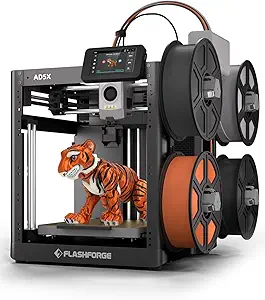
The FLASHFORGE AD5X Multi-Color 3D Printer redefines precision and speed for enthusiasts and professionals alike. Delivering vivid multi-color prints with up to four simultaneous colors, this high-speed CoreXY machine is engineered for detailed projects such as helmets, combining efficiency with exceptional print quality.
Equipped with 1-Click Auto Leveling for hassle-free setup, the AD5X boasts a remarkable 600mm/s printing speed and robust acceleration. Its versatile nozzle options and smart features like resume printing and remote monitoring provide unmatched control and reliability, making it an ideal choice for complex and large-scale 3D printing applications.
Pros
- Supports up to 4 colors simultaneously, enabling vibrant, multi-color 3D prints ideal for aesthetically complex projects like helmets.
- CoreXY architecture allows ultra-fast printing speeds up to 600mm/s with accurate acceleration (20,000mm/s²), reducing production time significantly.
- Flexible nozzle sizes from 0.25mm to 0.8mm accommodate both fine detail and rapid large-scale printing, enhancing versatility.
- Advanced features such as 1-Click Auto Leveling and resume printing optimize reliability and ease of use during extended print jobs.
- Remote print monitoring and control via the Flash Maker app increases convenience, especially during batch printing or complex builds.
Cons
- Weighing 24.2 pounds and sized at 16 x 14 x 18 inches, it may require a dedicated workspace for stable operation and ease of access.
Overall, the FLASHFORGE AD5X stands out as a versatile and high-performance 3D printer tailored for detailed, multi-color printing needs. Its speed, precision, and user-centric features make it particularly well-suited for producing helmets and other intricate, multi-material designs. A valuable investment for serious makers seeking quality and efficiency.
A valuable investment for serious makers seeking quality and efficiency.
7. Bambu Lab A1 3D Printer, Support Multi-Color 3D Printing, High

The Bambu Lab A1 3D Printer stands out as an exceptional choice for enthusiasts and professionals seeking the best 3D printer for helmets. Its high-speed precision combined with multi-color capabilities makes it perfect for crafting detailed, vibrant helmet designs effortlessly and efficiently.
Delivering an impressive acceleration of 10,000 mm/s², the A1 ensures fast yet precise prints. It supports multi-color printing via the AMS lite system, letting users produce complex, colorful helmets.
Full-auto calibration and active flow rate compensation enhance print accuracy, while a quiet operation and easy nozzle swaps make the entire process seamless.
Pros
- Exceptional speed and precision with 10,000 mm/s² acceleration for finely detailed helmet prints.
- Multi-color printing enabled through the AMS lite, allowing complex, eye-catching designs for helmets.
- Full-auto calibration removes manual hassle, delivering consistent Z-offset and bed-leveling accuracy.
Cons
- Multi-color printing requires additional purchase of AMS lite, which may increase overall investment.
Overall, the Bambu Lab A1 3D Printer excels as a versatile and reliable tool for helmet enthusiasts who demand speed, precision, and multi-color printing capabilities. Its advanced features and user-friendly design make it an excellent investment for anyone looking to elevate their 3D helmet creations.
8. Creality K1C 3D Printer, 3D Printers with 600mm/s Fast Printing

Discover the Creality K1C 3D Printer, engineered for impressive speed and precision with its blazing 600mm/s printing capability. Whether creating complex parts or intricate helmet designs, this model offers unmatched efficiency, making it an exceptional choice for enthusiasts seeking the best 3D printer for helmets and other detailed projects.
Combining powerful hardware and intelligent software, the Creality K1C features a spacious build volume of 66 x
66 x 84 inches, clog-free direct extruder with a durable steel-tipped copper nozzle, and smart AI-driven monitoring. Its user-friendly auto-calibration and upgraded cooling system ensure flawless prints with minimal effort.
Pros
- Exceptional printing speed of up to 600mm/s and 20,000mm/s² acceleration, delivering models up to 12 times faster than conventional 3D printers.
- Convenient plug-and-play setup with intuitive auto calibration including auto Z offset, leveling, and input shaping, saving time and simplifying operation.
- Advanced clog-free direct extruder supports high-temperature filaments up to 300°C, including carbon fiber, ensuring diverse material compatibility and robust prints.
- Smart AI camera provides real-time failure detection and remote monitoring, allowing users to stay informed and avoid print errors efficiently.
- Upgraded multi-fan cooling architecture enhances model quality by reducing stringing, warping, and improving layer bonding for sharp, detailed prints.
Cons
- Relatively large footprint (25 x 15 x 22 inches) may require dedicated space in smaller work areas.
Offering a remarkable balance between speed, precision, and ease of use, the Creality K1C is ideal for creators focusing on helmets and other detailed 3D printed projects. Its intelligent features and sturdy build make it a standout option within the mid-range 3D printer market.
9. Creality Halot-X1 Combo Resin 3D Printer, 10.1″ 16K Mono LCD,

Experience unparalleled precision and speed with the Creality Halot-X1 Combo Resin 3D Printer, designed for professional-grade helmet prototypes and detailed designs. Featuring a massive
The Halot-X1 Combo boasts a 3X faster printing speed of up to 170 mm/h and a generous build volume of 68 ×
37 × 200 mm, accommodating complex helmet models effortlessly. Its intelligent resin management system with quick heating and RFID recognition elevates printing reliability, while a fixed build plate and advanced Z-axis precision guarantee consistent accuracy.
Pros
- Ultra-high-resolution 16K mono LCD screen delivers intricate helmet details with exceptional clarity and sharpness.
- Innovative Intelligent AFU Resin Management System heats resin rapidly, reduces viscosity, and automates resin parameter settings to improve print success rates.
- Stable motion control with dual linear rails and lead screws ensures 0.01 mm Z-axis precision, maintaining dimensionally accurate and smooth surfaces.
Cons
- Weighing 37.4 pounds with substantial dimensions, it may require ample workspace and might be less portable compared to smaller resin printers.
Ideal for professionals and creators seeking the best 3D printer for helmets, the Creality Halot-X1 Combo offers unmatched detail, speed, and reliability. Its user-friendly features and intelligent systems simplify complex resin printing, making it a top contender in the industrial-grade resin printer category.
10. Kodak 3D Printer Portrait, White, 21.1 x 20.7 x 20.7

The Kodak 3D Printer Portrait offers precision and versatility, making it an excellent choice for enthusiasts seeking the best 3D printer for helmets. Its dual extrusion with lifting nozzles ensures complex geometries print accurately, while the fully enclosed chamber maintains optimal conditions for high-quality, reliable results.
Designed with a spacious build area (1 x
7 inches), the Portrait supports Wi-Fi, USB stick, and email connectivity for effortless file transfers. Automatic calibration and leveling simplify setup, and its controlled environment minimizes filament exposure to humidity and dust, enhancing print consistency and durability.
Pros
- Dual extrusion system with lifting nozzles allows precise printing of complex helmet designs and multi-material builds.
- Fully enclosed chamber offers a controlled printing environment, reducing warping and improving overall print safety.
- Multiple connectivity options (Wi-Fi, USB, email) streamline workflow, allowing convenient access from various devices.
Cons
- The printer’s relatively heavy weight (59.9 pounds) and size may limit portability or require dedicated workspace.
Ideal for users seeking reliability and precision in helmet 3D printing, the Kodak Portrait balances advanced technology with user-friendly features. Its controlled environment and connectivity options make it a standout choice within the professional desktop 3D printer category.
How to Choose the Best 3D Printer for Helmets
Print precision and performance
High print accuracy and consistent performance are essential to produce helmets that fit perfectly and boast professional-quality finishes. Precision in layer alignment and maintaining tight dimensional tolerances ensure the final product matches design specifications closely, which is critical for wearable items that require exact sizing and comfort.
Balancing print speed with quality allows for efficient production without sacrificing surface smoothness or structural integrity—faster settings can reduce production time but may introduce imperfections, while slower speeds enhance detail. Reliable, uninterrupted extrusion and steady filament feeding mechanisms prevent common print failures such as blobs or gaps, resulting in stronger, more reliable helmets.
Advanced printers featuring dual extrusion or multimaterial capabilities enable the integration of complex, multi-color designs or different filament types within a single print, adding realism and functional details without additional assembly. Moreover, machines equipped with sturdy frames and vibration-dampening components maintain stability throughout printing, minimizing artifacts and producing sleek, smooth surfaces crucial for both aesthetics and aerodynamic performance.
Temperature control and heated bed features
Accurate temperature management is essential for producing durable, high-quality helmet prints that meet safety and aesthetic standards.
Adjustable nozzle temperatures allow compatibility with a wide range of filament types, such as PLA, ABS, or carbon-fiber blends, each requiring specific heat settings to ensure proper melting and layer adhesion. A heated bed with adequate size and consistent temperature distribution is critical to prevent warping and ensure the first layers of curved helmet parts stick firmly during printing. Uniform heating helps maintain dimensional accuracy across large builds, avoiding costly print failures.
Uniform heating helps maintain dimensional accuracy across large builds, avoiding costly print failures.
Enclosed printing chambers stabilize ambient temperature, significantly reducing issues caused by drafts and sudden temperature fluctuations that can lead to warping, especially with materials prone to shrinkage like ABS. Proper cooling fan arrangements are also vital; directed airflow aids in controlled layer solidification, preserving smooth surface curves crucial for helmet designs. Finally, robust safety features, including thermal runaway protection and temperature cutoffs, safeguard users and equipment from the risks associated with high-temperature components, ensuring reliable operation during extended print jobs.
Build volume and size compatibility
The maximum build volume defines the physical size of objects that can be printed in a single run, making it a critical factor for creating helmets or large helmet components. Helmets typically require a spacious build area, often exceeding 200 x 200 x 200 mm, to produce full or substantial parts without the need for complex assembly.
Layer height and print resolution further influence the level of detail achievable, where finer layers (e.g.,
1 mm or below) enhance surface smoothness and intricate design fidelity, essential for comfortable, well-finished helmet prints.
In addition to size capabilities, the printer’s overall footprint impacts workshop or home placement; a larger printer must fit comfortably in available space without causing clutter or limiting workflow. Some users may prefer printing large helmet sections individually, which can then be seamlessly assembled, requiring a printer capable of precise dimensional accuracy across multiple prints. Alternatively, modular printing options with compatible custom or extended build plates expand the machine’s versatility, allowing for customized setups tailored to oversized projects.
Alternatively, modular printing options with compatible custom or extended build plates expand the machine’s versatility, allowing for customized setups tailored to oversized projects.
Ultimately, understanding these factors ensures the chosen printer can accommodate helmet dimensions while balancing resolution, workspace integration, and print strategy—key aspects that affect both print quality and user convenience.
Material compatibility and durability
High material compatibility and durability are essential for producing helmets that meet stringent safety and performance standards. The ability to print with robust filaments such as ABS, PLA+, PETG, and carbon fiber blends ensures that the resulting helmets can withstand impact, maintain structural integrity, and offer a combination of rigidity and flexibility vital for protective gear.
Durability plays a critical role in helmet functionality, as impact resistance directly influences user safety. Materials like PETG and carbon fiber composites provide enhanced toughness and resistance to cracking under stress, while ABS offers good overall toughness with some flexibility. Moreover, support for various filament diameters and spool types allows greater versatility in material choice and load capacity, which can affect print consistency and strength.
For helmets intended for outdoor use, resistance to UV rays and harsh weather conditions is crucial to prevent degradation and maintain safety over time. Specialty filaments formulated for safety gear often include additives for UV stability and improved wear resistance.
Such niche materials expand design possibilities while ensuring long-term durability, essential for helmets exposed to fluctuating environments and demanding use cases.
Ease of use and maintenance
Intuitive operation and straightforward upkeep are vital for ensuring smooth and consistent helmet fabrication. User-friendly interfaces paired with easy-to-navigate controls allow quick adjustments to complex helmet designs without steep learning curves, reducing time spent troubleshooting or configuring prints.
Features such as removable and flexible print beds simplify the often delicate process of detaching a large, intricate helmet print without damage or warping. Automated bed leveling and sensor-based calibration save hours of manual tinkering by ensuring the nozzle maintains optimal distance from the bed, critical for strong adhesion and layer consistency in multi-hour helmet prints.
Compatibility with slicing software and firmware that supports frequent updates ensures that helmet models can be processed efficiently while integrating new features or fixes without hassle. Together, these elements streamline the entire workflow from design adjustments through final print, making maintenance less daunting and improving the overall user experience for producing durable, accurate helmets.
Frequently Asked Questions (FAQs)
Are There Specific Features That Enhance Durability And Safety For Printed Helmets?
Yes, printed helmets enhance durability and safety through features like multi-layered infill patterns that improve impact absorption and reinforced outer shells using materials such as carbon fiber or high-strength PLA blends. Additionally, incorporating a smooth, uniform surface finish reduces stress points, while integrating internal padding and proper ventilation ensures comfort and protection during use.
How Important Is Print Material Compatibility When Choosing A Printer For Helmet Production?
Print material compatibility is crucial when choosing a printer for helmet production because helmets require durable, flexible prints that adhere well to curved, often textured surfaces. Selecting a printer that supports specialized inks and can handle materials like thermoplastics or composites ensures strong adhesion and longevity. Always verify the printer’s compatibility with your specific helmet materials to avoid cracking, peeling, or fading over time.
What Build Volume Should I Look For In A Printer To Create Full-Size Helmets?
For full-size helmets, aim for a printer with a build volume of at least 8 to 12 inches (20 to 30 cm) in each dimension to print most designs in one piece. If your helmet design is larger or more complex, consider a printer with a bigger build area or plan to print in multiple parts for assembly.
Which Printers Offer The Best Balance Of Resolution And Speed For Detailed Helmet Designs?
For detailed helmet designs, resin printers like the Anycubic Photon Mono X and Elegoo Mars series offer an excellent balance of high resolution (around 50-100 microns) and reasonable speed. These printers capture fine details clearly without significantly slowing down print times, making them ideal for intricate, high-quality models.
Can I Use The Same Printer For Making Helmet Prototypes And Final Wearable Models?
Yes, you can use the same 3D printer for both helmet prototypes and final wearable models, but ensure it offers high resolution and durable material compatibility for the final product. Prototypes can use faster, lower-resolution settings, while final models require stronger, impact-resistant materials like ABS or polycarbonate for safety. Always verify the printer supports the necessary print size and material certifications for wearable use.
Conclusion
In summary, the best 3D printer for helmets combines precision, durability, and customization to create safe and comfortable headgear tailored to your needs. These printers offer unmatched versatility, enabling users to bring intricate designs to life while ensuring functional strength and style.
Embrace the possibilities that 3D printing technology provides, and take the first step toward crafting your perfect helmet with confidence and creativity.