
In the realm of additive manufacturing, achieving seamless surface finishes often hinges on the effective use of post-processing materials designed to address inherent layer lines and minor imperfections. Among these, the best filler for 3D prints plays a critical role in enhancing structural integrity and aesthetic appeal, especially when working with common thermoplastics like PLA, ABS, or PETG. Selecting an optimal filler involves considerations of adhesion properties, curing time, sandability, and compatibility with subsequent coatings or paints.
As the demand for high-quality, prototyped components grows across industries, understanding the nuances behind filler formulations can dramatically improve final outcomes. Exploring the various types of fillers and their application techniques ensures that each print not only meets but exceeds expected standards.
What factors truly distinguish the best filler for 3D prints from the rest?
Discover Top Solutions to Achieve Flawless Surface Finishes in Your 3D Creations
| Image | Product | Price |
|---|---|---|
Our Pick 1  | 3D Printer Super Glue Thin for PLA, ABS, PETG, TPU | Check Price On Amazon |
Our Pick 2  | Bamboo Lab 3D Printer Bed Adhesive,3D Print Glue for Hot | Check Price On Amazon |
Our Pick 3  | UV Putty 5g—365-405nm Fast Cure, Sand & Paint Ready, Opaque | Check Price On Amazon |
1. 3D Printer Super Glue Thin for PLA, ABS, PETG, TPU
Achieve flawless bonds and professional-quality finishes with the 3D Printer Super Glue Thin designed specifically for PLA, ABS, PETG, TPU, and more. Its ultra-thin formula seeps into micro gaps, making it an essential adhesive for detailed assemblies and high-resolution 3D prints.
Engineered to work seamlessly with all major 3D print filaments, this transparent super glue offers a clean, strong hold without blooming or warping. The XXL 76 oz bottle provides extended usage, while the precision needle tip ensures mess-free, controlled application.
76 oz bottle provides extended usage, while the precision needle tip ensures mess-free, controlled application. Heat and water-resistant bonding up to 110°C makes it ideal for functional, outdoor, and electronic components.
Pros
- Ultra-thin formula penetrates tight seams and fine details, ensuring strong, invisible joints.
- Compatible with diverse filaments such as PLA, ABS, PETG, TPU, ASA, and Nylon.
- XL volume bottle offers long-lasting supply, perfect for hobbyists and professionals alike.
- Precision needle tip allows pinpoint application without clogging or waste.
- Heat and water resistance maintain bond integrity under demanding conditions.
Cons
- Higher price point compared to standard super glue options, reflecting specialized formulation.
For serious 3D printing enthusiasts and makers, this super glue combines precision application, filament compatibility, and durable bonding in a value-packed size. Compared to generic adhesives, it delivers superior performance tailored to the unique demands of 3D prints, making it the best filler for 3D prints on the market.
2. Bamboo Lab 3D Printer Bed Adhesive,3D Print Glue for Hot
Achieve flawless 3D prints with Bamboo Lab 3D Printer Bed Adhesive, a high-performance glue designed to secure models firmly during printing. Its strong, consistent grip prevents warping and lifting, making it an essential addition for enhancing print success and minimizing filament waste.
This specially formulated liquid adhesive delivers durable bonding across various materials such as PLA, PETG, ABS, and TPU, adhering seamlessly to build surfaces including glass, PEI, and aluminum plates. Easy to apply with a smooth liquid texture, it spreads evenly for quick setup and cleans effortlessly with water, offering a hassle-free user experience.
Pros
- Provides strong adhesion to prevent model lifting or warping during high-speed printing.
- Compatible with a wide range of filaments and build surfaces for versatile use.
- Water-soluble and odorless, ensuring safe, easy cleanup without residue or unpleasant smells.
Cons
- Not water-resistant once dried, requiring reapplication before each print session for optimal results.
For those seeking the best filler for 3D prints to enhance bed adhesion, Bamboo Lab’s 3D Printer Glue combines effective performance with ease of use, making it a top choice among adhesives. Its reliable bonding and effortless cleanup set it apart from solid glue sticks, delivering enhanced print quality consistently.
3. UV Putty 5g—365-405nm Fast Cure, Sand & Paint Ready, Opaque
Discover the ultimate solution for fast, durable repairs with the UV Putty 5g—365-405nm Fast Cure, Sand & Paint Ready, Opaque. Designed for precision and strength, this UV-curable putty is perfect for modelers, DIY enthusiasts, and professionals who demand swift, high-quality results on various surfaces.
Crafted from a high-hardness UV-curable resin, the putty achieves a robust 85D hardness after curing in under a minute using UV light (365-405nm). Its paste-like consistency allows effortless shaping and sanding, making it ideal for fixing scratches, chips, and cracks on materials including 3D prints, stone, wood, plastic, and more.
Pros
- Rapid curing time under 1 minute enhances workflow efficiency for quick repairs.
- High hardness and strength provide durable, long-lasting repairs with minimal shrinkage.
- Non-toxic, low-odor formula ensures safety without compromising performance.
Cons
- Not water resistant, limiting use in moisture-exposed applications.
An exceptional choice for repairing and detailing 3D prints and various surfaces, the FUNCRECOL UV Putty balances speed, strength, and ease of use. Compared to traditional fillers, its UV curing technology significantly reduces waiting times, delivering a seamless, paint-ready finish for professional-quality results every time.
4. UV Light Curing Putty for 3D Prints and Models,Fast Repair

Discover ultra-fast and effective repair solutions with the UV Light Curing Putty for 3D Prints and Models. Designed for quick fixes with curing times under one minute, this putty offers a smooth, durable finish, making it an essential accessory for model makers and DIY enthusiasts seeking professional results.
Crafted from fiber-reinforced resin composites, this putty features a toothpaste-like consistency that allows easy application and precise gap filling. Once cured with UV light (365~405nm), it hardens to a resilient 85D, providing a crack-resistant, waterproof, and heat-resistant surface perfect for repairing scratches, cracks, and pinholes across various materials including resin models, plastic, stone, and wood.
Pros
- Extremely fast curing time under 1 minute with UV light for efficient repairs
- Versatile use on a variety of surfaces such as 3D models, countertops, and furniture
- Can be sanded, painted, and polished to achieve a flawless, professional finish
Cons
- Requires a UV light source within 365~405nm range for curing
For anyone looking for the best filler for 3D prints, this UV curing putty stands out by combining speed, durability, and ease of use. Its ability to deliver a long-lasting, smooth finish makes it a superior choice compared to traditional fillers that demand longer curing times and cumbersome application.
5. Hortsun 16 Pcs UV Light Curing Putty Kit for 3D
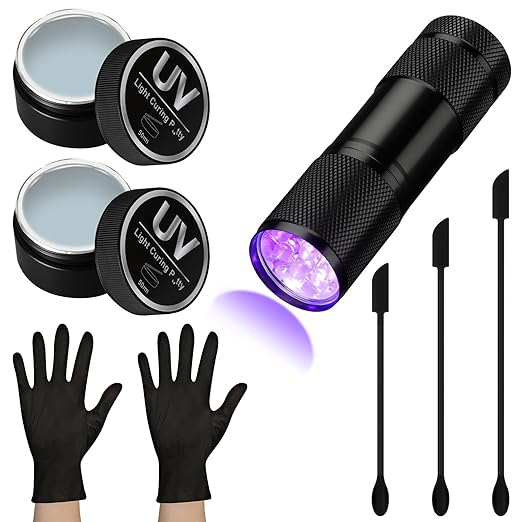
Discover the Hortsun 16 Pcs UV Light Curing Putty Kit—an essential tool for 3D print enthusiasts seeking precise repair and customization. This all-in-one set offers fast-curing putty paired with a powerful UV flashlight, providing an effective solution to fill gaps and refine intricate designs with ease and reliability.
The kit includes 100g of translucent UV curing putty, disposable gloves, silicone applicators, and a 395nm UV flashlight to solidify repairs quickly. Ideal for both hobbyists and professionals, it ensures durable bonding, invisible touch-ups, and smooth sculpting on resin models, enhancing your creative projects and prototypes.
Pros
- Rapid cure in 1-2 minutes using the powerful 395nm UV flashlight for efficient workflow.
- Translucent putty allows for seamless painting and sanding, preserving model aesthetics.
- Complete kit with gloves and silicone applicators enhances convenience and precision.
Cons
- The putty has a gel-like consistency, limiting its ability to be molded into solid shapes.
For those needing a swift, reliable fix to 3D resin prints without complicated setups, the Hortsun UV curing putty kit delivers practical performance. While it may not replace traditional moldable putties, its fast curing and translucent finish make it an excellent choice for detailed repairs and modifications.
6. Magigoo – MO2016 All-in-One 3D Printer Adhesive Glue – ABS,

Magigoo MO2016 All-in-One 3D Printer Adhesive Glue offers a reliable solution to keep 3D prints firmly attached during the printing process. Compatible with a wide range of filaments and build surfaces, this adhesive is designed to simplify your 3D printing experience while delivering professional-grade results every time.
Engineered for versatility, Magigoo works flawlessly with ABS, PLA, PETG, HIPS, and TPU filaments, bonding seamlessly to surfaces like Flex Plate, Glass, PEI, Buildtak, and Kapton. Its easy application, long-lasting formula, and odorless composition make it a top choice for both hobbyists and professionals seeking consistent print adhesion and easy release.
Pros
- Strong adhesion across multiple filament types, including ABS, PLA, and PETG
- Compatible with various build surfaces such as glass, PEI, and Flex Plate
- Effortless application and water-cleanable formula that won’t produce unpleasant odors
Cons
- Applying too much pressure on the bottle can cause the applicator cap to pop off, requiring careful handling
With its strong, durable bonding capabilities and ease of use, Magigoo MO2016 stands out as a dependable adhesive that enhances print quality without complicated preparation or cleanup. Ideal for diverse projects, it outperforms many standard adhesives by offering a balance of performance, convenience, and safety for all 3D printing enthusiasts.
7. 3D Printing Glue, CA-Based Adhesive, Fast-Drying & Precision Application, Works

Enhance your 3D printing projects with the 3D Printing Glue, a high-performance CA-based adhesive designed specifically for rapid bonding and precision application. Trusted by hobbyists and professionals alike, it delivers a reliable and clean solution for assembling and repairing prints made from various materials.
This fast-drying adhesive bonds PLA, ABS, PETG, resin, and more with industrial-strength durability. Supplied in a convenient 40g squeeze bottle with a precision tip, it allows for targeted application on intricate parts. Ideal for post-processing and reinforcement, it is a vital addition to every 3D printing toolkit.
Ideal for post-processing and reinforcement, it is a vital addition to every 3D printing toolkit.
Pros
- Strong and quick bond compatible with multiple 3D printing materials
- Precision tip ensures clean, targeted glue application on small components
- Clear-drying formula with low viscosity for effortless spreading and minimal mess
Cons
- Not water-resistant, therefore unsuitable for outdoor or moisture-exposed applications
Combining speed, strength, and precision, this adhesive outperforms many generic glues by offering industry-grade bonding tailored to 3D printing needs. If you are looking for the best filler for 3d prints that guarantees lasting adhesion without clogging or odor issues, this glue is an excellent choice at an affordable price.
8. Creality 2kg Black & White PLA 1.75mm Filament Bundle for

Unlock superior 3D printing performance with the Creality 2kg Black & White PLA 75mm Filament Bundle. Offering reliable quality in two classic colors, this filament pack ensures smooth, strong, and consistent prints suitable for both functional prototypes and detailed display models.
Offering reliable quality in two classic colors, this filament pack ensures smooth, strong, and consistent prints suitable for both functional prototypes and detailed display models.
Designed using a patented manufacturing process, each 1kg spool delivers smooth, clog-free extrusion with exceptional layer adhesion and durability. Compatible with 99% of FDM and FFF printers featuring heated beds, this eco-friendly PLA filament combines renewable plant-based materials with enhanced toughness for versatile and dependable printing results.
Pros
- Cost-effective 2kg bundle combining black and white spools, perfect for versatile printing needs
- Consistent diameter and smooth extrusion minimize printing errors and deliver sharp detail
- Improved toughness and excellent overhang performance reduce supports and post-processing
Cons
- Limited to black and white colors; lacks vibrant or specialty shades for creative projects
For those seeking the best filler for 3D prints with reliable consistency and value, Creality’s PLA filament bundle stands out as a dependable choice. Its balanced quality, environmental friendliness, and compatibility make it a solid option compared to pricier or less consistent alternatives on the market.
9. 150ml 3D Printer Adhesive Glue, Perfect First Layer Adhesion, Prevents

Enhance your 3D printing experience with the 150ml 3D Printer Adhesive Glue, designed to ensure perfect first layer adhesion and drastically reduce print failures. Its powerful formula makes every print more reliable by preventing common issues like warping and shifting, offering a seamless start to your projects.
Specifically crafted for diverse printing surfaces—including glass, PEI sheets, aluminum, and Buildtak Boards—this adhesive supports a wide range of filaments like PLA, PETG, ASA, TPU, and ABS. The water-soluble, odor-free formula is easy to apply and clean, allowing multiple prints per coating and providing excellent value for frequent users.
Pros
- Strong adhesion improves print bed grip and reduces warping or shifting
- Compatible with various build surfaces and multiple filament types
- Large 150ml volume supports over 120 coatings, enabling up to 1200 prints per purchase
- Odorless and safe formula eliminates unpleasant smells during heating
- Easy application with a water-soluble formula that cleans quickly and effortlessly
Cons
- May require reapplication for extremely large or complex prints
Offering exceptional adhesion performance at an affordable price, the 150ml 3D Printer Adhesive Glue is an excellent choice for both hobbyists and professionals. Compared to other adhesives that may emit strong odors or support fewer reuses, this product stands out by delivering reliable results, ease of use, and long-lasting coverage in one bottle.
10. FIROS 3D Pen Filament Refills, 18 Colors 3D Pen PLA

Elevate your 3D pen creations with the FIROS 3D Pen Filament Refills, featuring a vibrant collection of 18 colors including solid, fluorescent, and metallic shades. Perfect for artists and hobbyists alike, these filaments ensure your 3D drawings are bright, precise, and hassle-free.
Crafted from eco-friendly PLA material, FIROS filaments offer a consistent 75mm diameter compatible with most 3D pens on the market (excluding 0 mm models).
With 180 feet of filament in total, quick melting between 180°C-220°C guarantees smooth, bubble-free printing for detailed and vivid 3D artwork.
Pros
- Wide color variety with 18 vibrant shades including metallic and fluorescent options for diverse artistic expression.
- High compatibility with most 1.75mm 3D pens ensures easy use without frequent filament jams.
- Eco-friendly PLA composition promotes safer crafting with fast forming and bubble-free extrusion.
Cons
- Not compatible with 3.0 mm 3Doodler pens, limiting use to certain pen models.
FIROS 3D Pen Filament Refills provide excellent value through extensive color options and reliable performance, making it an ideal choice for anyone looking to bring their 3D sketches to life with ease and vibrancy.
Top Fillers to Perfect Your 3D Prints Every Time
Filler strength and durability
When considering filler strength and durability for repairing or finishing 3D prints, it is important to choose materials that offer excellent impact resistance to withstand everyday wear and tear. The filler should also maintain its integrity under varying weather conditions and temperatures, ensuring that your repair or finish does not degrade quickly when exposed to the elements.
Longevity of repair or fill plays a crucial role in maintaining the appearance and structural integrity of your print over time, so opting for a filler that bonds well and cures to a hard, durable surface is key. Evaluating these factors will help you select the best filler for 3D prints that meets your specific needs and guarantees a lasting, reliable result.
Toxicity and safety
When considering toxicity and safety for materials used to enhance your 3D prints, it is important to be aware of the presence of harmful chemicals or fumes that could be released during application or curing. Some fillers may emit strong odors or volatile organic compounds, which is why good ventilation is essential to ensure a safe working environment.
Working in a well-ventilated space or using a fume extractor can help reduce the risk of inhaling potentially hazardous substances. Additionally, taking precautions to avoid skin contact is advisable since certain compounds in fillers can cause irritation or allergic reactions. Wearing gloves and washing hands thoroughly after handling these materials will help protect your skin.
By keeping these safety considerations in mind, you can confidently choose and use fillers while minimizing any health risks associated with their use.
Viscosity and texture
When considering the best filler for 3d prints, it is important to pay close attention to viscosity and texture since these qualities determine how well the filler performs on various surfaces. A filler with the right thickness should be chosen to effectively address different print defects; thicker fillers are ideal for filling large holes, while thinner ones work better on fine gaps and small imperfections.
Smoothness upon application is another key aspect because a filler that spreads evenly without clumping will save time and effort during sanding and finishing. Selecting a filler that balances viscosity and texture ensures it adheres properly to the print, provides a seamless finish, and offers versatility across multiple use cases, whether repairing cracks, smoothing layer lines, or enhancing surface details. Keeping these considerations in mind will help you make an informed decision and achieve professional-quality results in your 3d printing projects.
Material compatibility
When selecting the best filler for 3d prints, it is important to consider material compatibility to ensure a smooth and durable finish. Different types of 3D print materials supported by the filler include PLA, ABS, resin, and nylon, each with unique surface textures and properties.
A good filler must have strong adhesion properties to bond well with these materials, preventing cracks or peeling after application. Additionally, flexibility and shrinkage after curing play a crucial role, as fillers that become too rigid might crack when the print flexes, while those with excessive shrinkage can create gaps or uneven surfaces. The application method and ease of use should also be taken into account; fillers that spread smoothly with brushes or spatulas and dry quickly allow beginners to achieve professional results without frustration.
Considering these factors can help you choose a filler that harmonizes well with your specific 3D printing projects, resulting in seamless repairs and polished final products.
Price and quantity
When searching for the best filler for 3d prints, it is important to consider both the product’s costeffectiveness based on volume and the available packaging options. Many fillers come in different quantities, so choosing the right size can ensure that you are not overspending or running out too quickly during your projects.
Evaluating the value compared to performance means looking beyond just the price and considering how well the filler adheres, sands, and finishes on your prints. A slightly higher-priced filler that delivers smoother results and requires less product per fill might ultimately be more economical.
Additionally, ease of application and compatibility with the type of filament you print with are important use case factors that can influence your satisfaction. By balancing these aspects, you can select a filler that aligns with your budget, project demands, and desired finish quality.
FAQ’s
What Is The Best Filler For Fixing Layer Lines On Pla Prints?
The best filler for fixing layer lines on PLA prints is typically a high-quality acrylic or polyester filler like Bondo, which sands smooth and adheres well to PLA. Alternatively, using a PLA-specific filler or a mixture of wood filler can also effectively smooth out imperfections.
Can Epoxy Resin Be Used As A Filler For Prints, And What Are Its Advantages?
Yes, epoxy resin can be used as a filler for prints, providing a smooth, glossy finish and strong adhesion. Its advantages include durability, resistance to moisture, and the ability to fill gaps or imperfections effectively.
What Are The Most Effective Fillers For Smoothing Printed Models?
The most effective fillers for smoothing printed models are polyester-based putties and epoxy fillers, as they provide a smooth, sandable surface and adhere well to various materials. Additionally, spray-on primers and automotive filler primers are commonly used to fill small imperfections before final sanding and painting.
How Do Different Fillers Compare In Terms Of Drying Time And Ease Of Use For Prints?
Different fillers vary in drying time, with epoxy-based fillers generally drying faster than plaster or acrylic fillers. In terms of ease of use, acrylic fillers are often preferred for prints due to their smooth application and sandability, while plaster fillers can be more brittle and harder to work with.
Are There Any Eco-Friendly Fillers Suitable For Printed Objects?
Yes, there are eco-friendly fillers for printed objects, such as bamboo fiber, recycled wood, and biodegradable PLA additives. These materials help reduce environmental impact while maintaining print quality and durability.
Conclusion
In summary, the best filler for 3D prints depends on the specific project needs, but popular options like epoxy putty, Bondo, and specialized 3D print fillers stand out for their ease of use and excellent finishing results. Choosing the right filler enhances surface smoothness and durability, ensuring professional-quality prints every time.